
Introduction
Skilpadjies—literally “little tortoises,” named for their dappled, shell-like look—are a beloved part of South Africa’s offal tradition. Liver is minced or finely chopped, lightly seasoned, sometimes blended with a little mince for gentler flavour, then wrapped in caul fat and cooked over medium coals. The caul renders and crisps, basting the parcel while keeping the interior tender and juicy. Served hot off the grid with lemon, chutney, or apricot glaze, skilpadjies are rich, deeply savoury, and unapologetically indulgent—made for braai gatherings where small plates pass from hand to hand.
Good skilpadjies balance flavour and texture: a smooth, gently seasoned filling; neat, overlapping wraps of caul; and patient cooking over steady heat. With a few smart techniques, you can turn this heritage snack into your next braai showstopper.
Tips & Techniques
- Source & prep the caul (netvet): Ask your butcher for lamb or pork caul fat. Keep it very cold so it handles easily. Soak briefly in cold water with a squeeze of lemon to remove any odour, then pat dry.
- Tame the liver flavour: If desired, soak chopped liver in milk for 20–30 minutes, then drain and pat dry before mixing—this mellows intensity without muting character.
- Season thoughtfully: Salt, black pepper, garlic, onion, parsley, coriander seed, and a whisper of nutmeg or mild curry powder are classic. Don’t over-salt—caul fat carries flavour.
- Bind & chill: A spoon or two of fine breadcrumbs or oats helps the filling hold. Chill the mixture for 15–30 minutes for cleaner shaping.
- Wrap with overlap: Lay the caul flat, add a small patty of filling, then fold edges over so seams overlap. Keep the seam-side down when cooking to seal.
- Skewer or grid: Thread onto skewers or clamp in a hinged braai grid to prevent sticking and make turning easier.
- Medium, steady heat: Braai over medium coals (you should hold your hand ~12–15 cm over the grid for 5–6 seconds). High heat scorches the outside before the centre is done.
- Manage flare-ups: Fat will drip—set up a two-zone fire. If flames jump, move parcels to the cooler side briefly. Closing a kettle lid also tames flare-ups.
- Turn often, glaze late: Turn every 1–2 minutes for even rendering. Brush any sweet glaze (apricot jam + chutney + splash of vinegar) in the final minute to avoid burning.
- Doneness: Cook until the exterior is well browned and crisp and the centre is just cooked (slightly rosy is traditional). If you prefer fully done, aim for ~70 °C internal temperature.
- Rest & serve: Rest 2–3 minutes to settle juices. Serve hot with lemon wedges and something tangy to cut richness.
Delicious Variations
Flavour Profiles
- Cape Malay-Style: Mild curry powder, ground coriander and cumin, chopped coriander leaves; finish with a light apricot-chutney glaze.
- Garlic & Herb: Fresh parsley, thyme, lemon zest, and a touch of crushed garlic for bright, green lift.
- Peri-Peri: Add fresh chilli or peri-peri sauce to the filling; baste with peri-peri in the last minute of cooking.
- Smoky Paprika: Sweet or smoked paprika in the mix, finished with a squeeze of lemon.
Texture & Binding
- Mince Blend: 50/50 lamb liver and lamb mince for a milder, more tender patty.
- Rustic Chop: Hand-chopped liver for a chunkier, old-school texture.
- Light Binder: Fine breadcrumbs, oats, or a crushed rusk to hold shape without heaviness.
Cooking Methods (Beyond the Braai)
- Oven + Grill: Bake on a rack over a tray at 200 °C until nearly done, then finish under a hot grill for a crisp exterior.
- Pan + Oven: Start in a dry or lightly oiled cast-iron pan to render, then finish in the oven to cook through without scorching.
- Air-Fryer: 190–200 °C on a rack, turning once; watch for smoke from rendered fat and line the drawer to catch drips.
Serving Suggestions
- Braai Plate: Skilpadjies with pap, chakalaka, and a crisp slaw or green salad.
- Roosterkoek Rolls: Split warm roosterkoek, tuck in a parcel, add atchar or tomato-onion smoor.
- Snack Platter: Serve halved with lemon wedges, pickled onions, and gherkins to cut the richness.
- Sunday Lunch: Pair with geelrys, roasted veg, and a spoon of chutney.
Frequently Asked Questions (FAQs)
Q1: Where do I find caul fat?
Ask your butcher for lamb or pork caul (netvet). It’s often frozen; thaw gently in the fridge. Keep it very cold while working so it doesn’t tear.
Q2: Can I make skilpadjies without caul fat?
Yes—wrap in thin bacon or pancetta, or shape patties and cook in a lightly oiled pan. Bacon changes the flavour and salt level but still yields a tasty result.
Q3: How do I stop flare-ups on the braai?
Use a two-zone fire, keep a cooler side ready, and close the lid to deprive flames of oxygen. A drip tray under the grid helps catch fat.
Q4: My parcels fell apart—what went wrong?
Likely too little overlap or over-stuffing. Use enough caul to wrap securely, chill the filling, and cook seam-side down first. A skewer through the seam can help.
Q5: Can I make them ahead?
Yes. Shape and wrap, then chill up to 24 hours, or freeze on a tray until firm and bag. Thaw overnight in the fridge before cooking.
Q6: How do I reduce strong liver taste?
Soak in milk briefly, blend with some lamb mince, add fresh herbs and lemon zest, and avoid overcooking (which intensifies bitterness).
Q7: Oven timing guide?
On a rack at 200 °C, small parcels typically take 15–20 minutes; finish under the grill for extra crispness. Turn once and watch closely near the end.
Q8: What internal temperature is best?
Traditional skilpadjies are cooked until just blushing inside. For fully cooked, aim for ~70 °C in the centre while keeping the outside from over-browning.
Q9: Leftovers—how to reheat?
Reheat in a 180 °C oven or air-fryer until hot and re-crisped. Microwaving softens the exterior.
Nutritional Notes & Cultural Background
Skilpadjies celebrate nose-to-tail eating: rich in iron and vitamin A from liver, and high in fat from the caul—best enjoyed in modest portions alongside fresh, acidic sides. Culturally, they’re fixtures of Afrikaner braai culture and broader South African gatherings, where offal is prized for flavour and thrift. The name reflects their look—little “tortoises” with a patterned, crisp shell—while the taste speaks of open fires, shared plates, and time-honoured butchery traditions.
In Summary
Perfect skilpadjies are all about balance: neat wraps, gentle seasoning, and steady heat that renders and crisps without drying the centre. Manage flare-ups, glaze late, and serve with something bright and tangy. Master the technique once, and these heritage parcels will become a much-requested star of your braai table.
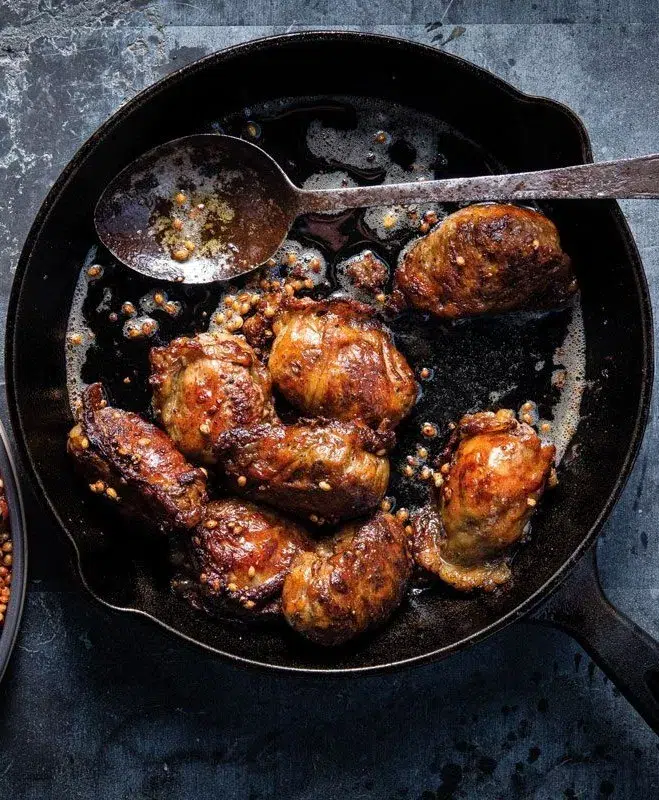
Skilpadjies
Ingrédients
- 500 g lamb liver finely minced
- 1 small onion finely chopped
- 1 tsp ground coriander
- Salt and black pepper to taste
- Caul fat (netvet) enough to wrap into small parcels
- Toothpicks or skewers (optional, for securing)
Instructions
- Mix the minced liver with chopped onion, coriander, salt, and pepper in a bowl.
- Cut the caul fat into pieces large enough to wrap around a tablespoon of filling.
- Place a spoonful of the liver mixture in the centre of each piece of fat and fold it neatly into a ball.
- Secure with a toothpick or skewer if needed.
- Grill over medium heat coals or in a pan until the fat is golden and crisp, and the liver is cooked through. Turn often to avoid burning.